The Chaos of a Messy Invoice Batch System Download
Enterprise resource planning (ERP) platforms, billing software, and corporate databases share a frustrating trait: they generate unreadable filenames. If your daily workflow involves managing high-volume data streams, you can automate your file workflows with Splicebatch. You pull an extract from a server, and the system spits out a confusing, unstructured text string like invoice_batch_system_download_77392.csv.
This formatting becomes a real operational issue when these spreadsheets accumulate in your local storage paths. Failing to properly catalog an Excel master sheet makes your data pipeline look highly disorganized. Opening Windows Explorer and manually executing a bulk rename is an inefficient use of valuable operational time. Furthermore, a lack of strict file frameworks makes it incredibly easy to accidentally overwrite critical historical data sheets during high-volume reporting periods.
The operational reality: An unstructured folder directory slows down crucial business closing periods and creates severe audit vulnerabilities. Learning how to organize automated system download batches is one of the easiest ways to streamline your data pipelines.
Option 1: Standard Mode for Quick Fixes
If you just need to add a quick prefix, suffix, or uniform file name to a batch of documents, Splicebatch’s Standard Mode is your fastest route.
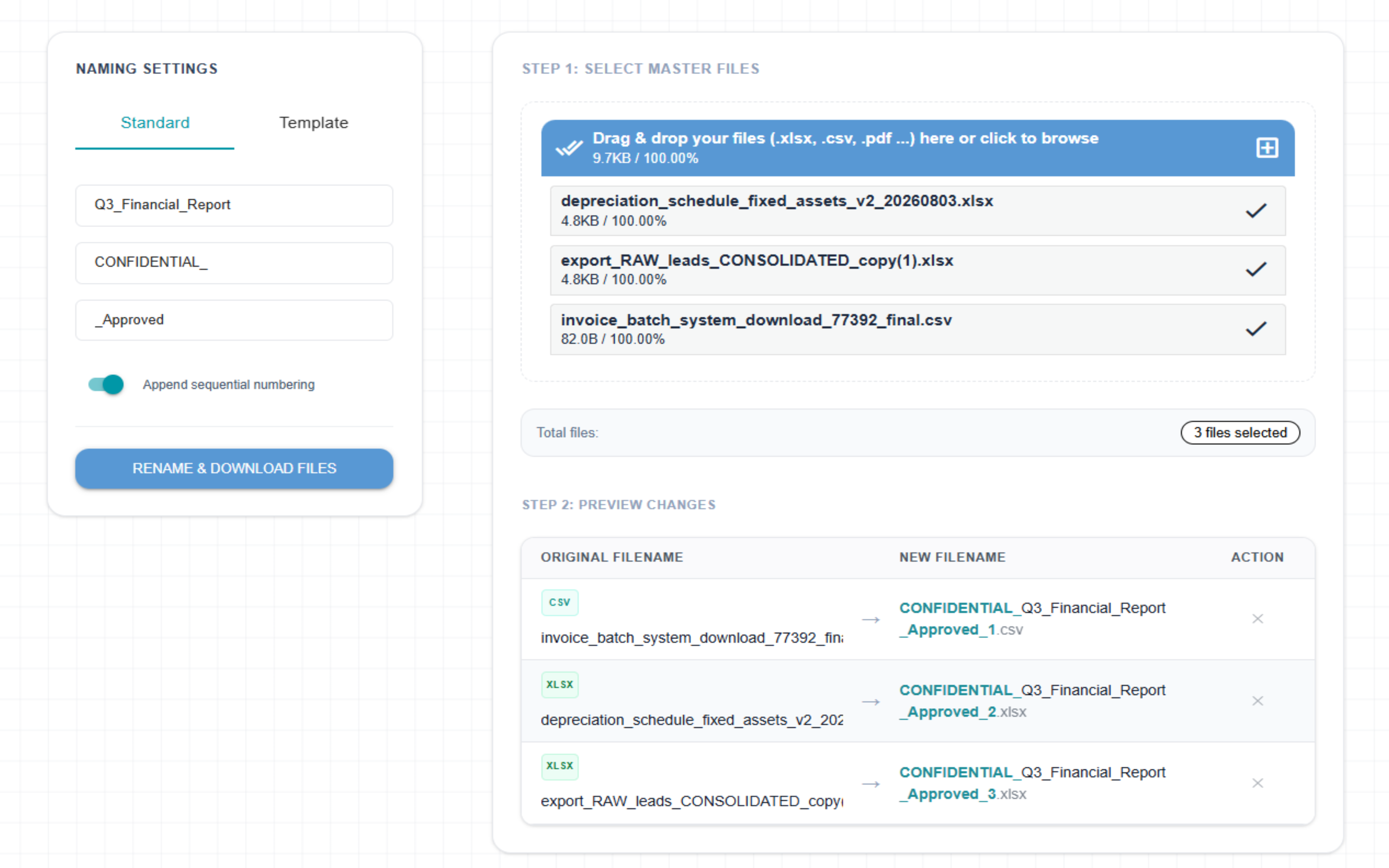
- Navigate to the main dashboard and drop your messy raw files into the Upload Batch sandbox.
- Under Standard Settings, type a unified Base File Name, or simply add text like
Confidential_to the Prefix input. - Toggle Append sequential numbering to guarantee that multiple files don’t overwrite each other.
The standard engine instantly injects clean text adjustments, formatting dozens of files simultaneously without risking brittle VBA macros. This workflow ensures you can later combine separate Excel sheets cleanly, as every file source remains perfectly indexed.
Option 2: The Power of Advanced Dynamic Templates
For complex business architectures or automated workflows requiring hyper-specific date formats, manual rules-based typing is obsolete. Splicebatch now features an Advanced Template Engine that automatically injects real-time system context directly into your files using structured tokens.
By switching to the Template tab, you can craft dynamic naming structures tailored to European or global accounting frameworks. The engine replaces placeholders with live variables instantly:
[YYYY]/[YY]– Live calendar year (e.g.,2026or26).[MM]/[DD]– Leading-zero month and day tracking (e.g.,07,09).[ORIGINAL]– Retains the foundational raw filename while safely stripping out unwanted symbols.[COUNTER]– Injects a smart sequential index (01,02,03…) anywhere in your layout to prevent accidental data duplication.
Global Format Flexibility: The parser explicitly supports standard delimiters like dots (
.) and dashes (-). European operations can safely map templates like[DD].[MM].[YYYY]_Invoice_[COUNTER]to generate boardroom-ready outputs like09.07.2026_Invoice_01.xlsxinstantly. Any dangerous characters like slashes (/) are automatically sanitized to safe underscores (_) to prevent file-system directory crashes.
Structural Comparison: Standardizing System Downloads
| Naming Variable | Raw Unstructured System Dump | Dynamic Template Output |
|---|---|---|
| Example Form | invoice_batch_system_download_77392.csv | [YYYY].[MM].[DD]_GlobalCorp_[COUNTER].csv |
| Resulting Name | invoice_batch_system_download_77392.csv | 2026.07.09_GlobalCorp_01.csv |
| Context Level | Low. Requires opening the file to see the origin. | High. Shows date, client, and batch index instantly. |
| Data Safety | High risk of file duplication or manual overwrites. | Secure. Time and counter tokens strictly isolate iterations. |
Frequently Asked Questions
Can I separate a single system download into different sheets?
Yes, absolutely. If your raw system dump arrives as a massive, multi-row document, you can automatically run our automated tools to safely split a master Excel sheet into standalone client workbooks.
Does this process store our financial reports on an external server?
No. Security is a foundational pillar of our architecture. Splicebatch utilizes client-side operations, meaning your financial figures, accounting rows, and cell contents are processed locally and are never read, stored, or exposed to outside cloud infrastructure.
Why do my downloads get flagged with random numerical IDs?
Most automated servers apply database indexing keys (like _77392) to guarantee file uniqueness within the backend server code. With Splicebatch, you can completely replace these messy server keys. By using a clean structure in the Template tab (such as [YYYY]_[MM]_Invoice_[COUNTER]), the engine bypasses the chaotic original filename entirely and generates brand-new, boardroom-ready assets instead.
Next Steps for Data Autopilot
Do not let raw system dumps dictate your team’s productive hours. Transitioning from reactive manual organization to an automated batch infrastructure saves hours of administrative overhead every single week.
Ready to clean up your file directory? Try Splicebatch today to instantly transform your system exports into boardroom-ready assets.